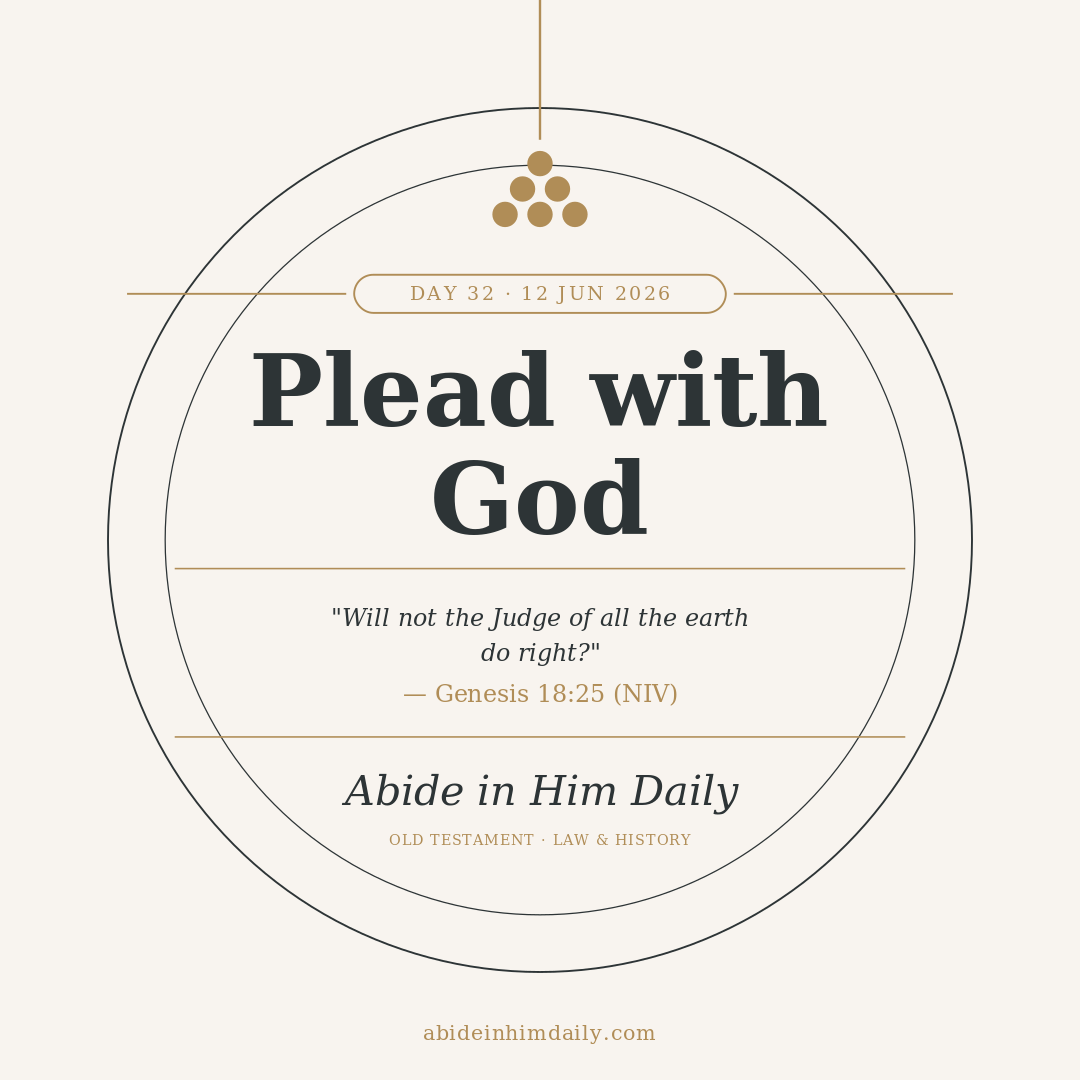
Plead with God
Day 32 · Genesis 18:23, 25
📖 TODAY’S SCRIPTURE
Genesis 18:23, 25 (NIV)
“Will you sweep away the righteous with the wicked?… Far be it from you to do such a thing — to kill the righteous with the wicked, treating the righteous and the wicked alike. Far be it from you! Will not the Judge of all the earth do right?”
Today’s John 15 thread: The branch that abides knows the heart of the Vine. Abraham’s boldness in prayer was not presumption — it was intimacy. He knew God well enough to remind God of His own character. That is what staying connected produces: prayer that flows from knowing, not just asking.
✍️ REFLECTION
This is one of the most remarkable conversations in the whole Bible.
Abraham is standing before God, and God has just told him that Sodom and Gomorrah are going to be destroyed because of their wickedness. And Abraham — instead of just accepting it and walking away — starts to plead.
“Will you sweep away the righteous with the wicked? What if there are fifty righteous people in the city? Will you really sweep it away and not spare the place for the sake of the fifty righteous people in it?”
He is not questioning whether God has the right to do what He’s about to do. He is reminding God of His own character. “Will not the Judge of all the earth do right?”
That is bold. That is the prayer of a man who knows who he is talking to.
Q1: Do you tend to pray based on how you feel in the moment — or based on what you know about God’s character? What difference does it make when you pray from what you know?
What I love about Abraham here is that he is not telling God his feelings. He is quoting God’s own nature back to Him. God is righteous. God is just. God is the Judge of all the earth. And because of who He is — Abraham makes his case.
That is what real boldness in prayer looks like. It is not about volume or emotion. It is about knowing the will of God based on His character — and praying from that place.
Abraham goes from fifty righteous to forty-five. Then forty. Then thirty. Then twenty. Then ten. He kept going. And God heard him every time.
God knew there weren’t even ten righteous people in Sodom. But He found Lot and his family, and He made a way for them to escape — because of Abraham’s prayer. Genesis 19:29 says it plainly: “When God destroyed the cities of the plain, he remembered Abraham, and he brought Lot out of the catastrophe.”
God responded to a righteous man who had the boldness to stand in the gap and plead on someone else’s behalf.
Q2: Is there a person or a situation you feel a pull to intercede for — to stand between them and what they’re facing and plead their case before God? What’s stopping you from being bold about it?
1 John 5:14-15 says: “This is the confidence we have in approaching God: that if we ask anything according to his will, he hears us. And if we know that he hears us — whatever we ask — we know that we have what we asked of him.”
The confidence is not in our words. The confidence is in knowing who He is — and asking according to what He has already said about Himself.
Life’s best outlook is a prayerful uplook.
Q3: Is there a prayer you’ve stopped praying because it didn’t seem to be working? What would it look like to go back — like Abraham — and keep going?
🌿 REMAIN IN HIM
Take a moment before you move on. This isn’t a to-do. It’s an invitation to stay.
Reflect honestly: Who are you carrying before God right now — a family member, a friend, a city, a situation — that needs someone to stand in the gap? Are you actually praying for them? Or have you just been worrying about them?
Bring it to Jesus: Come with boldness — not because of who you are, but because of who He is. Remind yourself of His character. Then bring the person or situation to Him from that place. Don’t stop at round one.
Trust the Gardener: The Gardener hears the branch that stays close enough to know His heart. Boldness in prayer is a fruit of abiding. The closer you stay, the more clearly you know what to ask — and how.
🙏 PRAYER
Father, thank You for speaking through Your Word today. Thank You that I can come to You with boldness — not because I have it all together, but because You are the Judge of all the earth, and You always do right. Give me the boldness of Abraham. Help me to pray from what I know about You, not just from how I feel. And put someone on my heart today to intercede for — someone who needs a person to stand in the gap. I am willing to be that person. In Jesus’ name, Amen.
💡 MEMORY VERSE
1 John 5:14 (NIV) — “This is the confidence we have in approaching God: that if we ask anything according to his will, he hears us.”
This post is part of the Abide in Him Daily devotional series — reading Scripture through the lens of John 15:1–17. The branch doesn’t manufacture the fruit. It bears it because it stays connected to the Vine.