Ten Commands, Not Ten Suggestions
Day 50 · Exodus 20:2-3
📖 TODAY’S SCRIPTURE
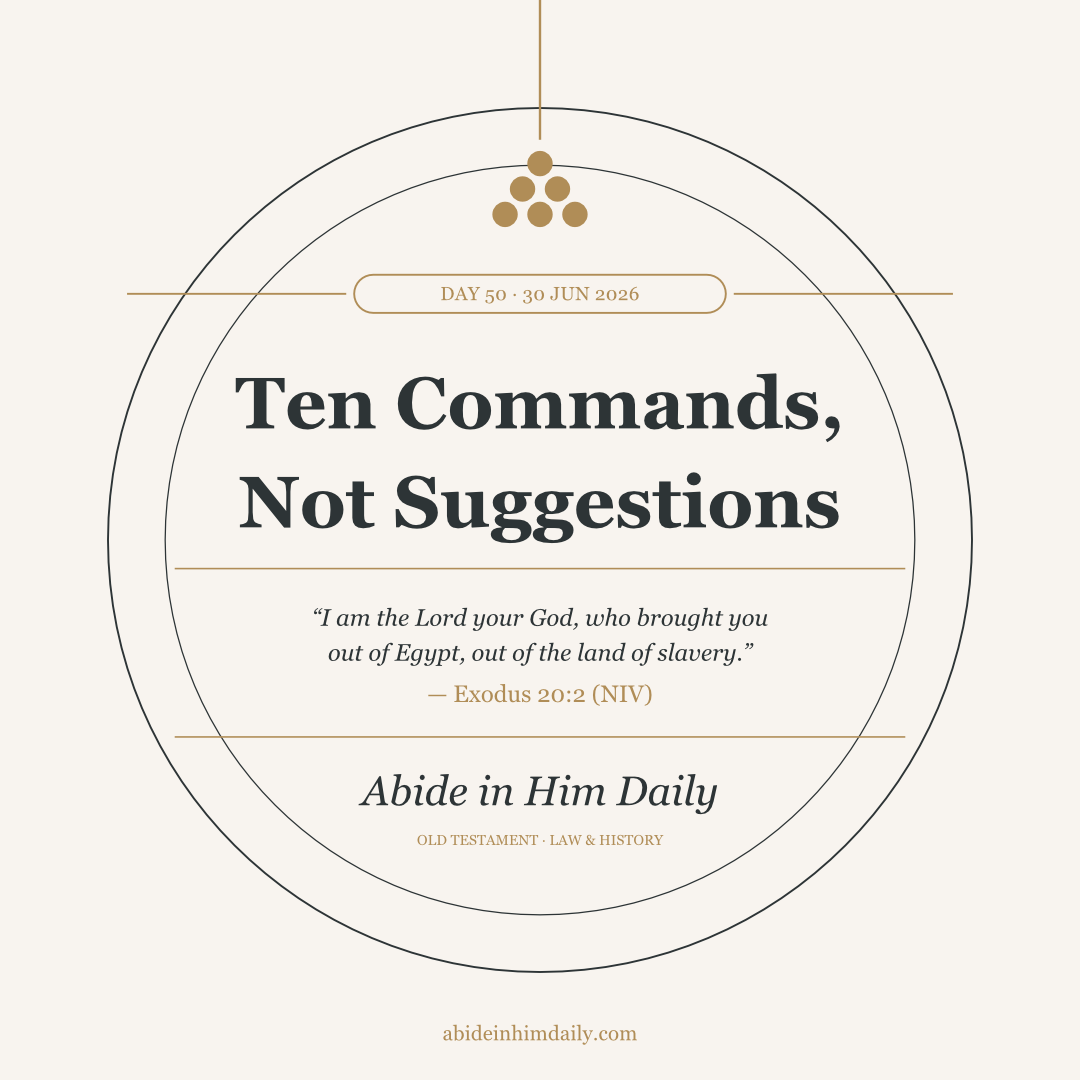
Exodus 20:2-3 (NIV)
“I am the Lord your God, who brought you out of Egypt, out of the land of slavery. You shall have no other gods before me.”
Today’s John 15 thread: “If you keep my commands, you will remain in my love.” Jesus said it in John 15. God said it at Sinai. The commands are not a burden, they are the path to remaining in Him. The Ten Commandments did not come from a distant rule-maker. They came from the God who had just brought His people out of slavery. The instructions and the love come from the same place.
✍️ REFLECTION
Before God gives even one of the Ten Commandments, He says something important: “I am the Lord your God, who brought you out of Egypt, out of the land of slavery.” He starts with what He has done, not with what He demands. He establishes the relationship first, I am your God, I am the one who rescued you, and then He gives the commands. That order matters.
The commandments do not come from a God who is distant, looking for reasons to punish you. They come from a God who just parted a sea for you, who rained down bread from heaven for you, who promised you a land of your own. The one who commands is the one who loves.
Q1: Do you tend to experience God’s commands as coming from love, from Someone who knows what is good for you, or from obligation and duty? Where did that view come from?
In Exodus 16:4, God says something about the manna: “In this way I will test them and see whether they will follow my instructions.” And in verse 28: “How long will you refuse to keep my commands and my instructions?” God takes obedience to His instructions seriously, not because He is looking for excuses to be angry, but because He knows that the instructions are the path to life. They are not random rules. They are the shape of a life that works.
Here is a question worth sitting with: if God thought we needed ten suggestions, He would have given ten suggestions. He gave ten commandments because the stakes are real and because He is serious about our flourishing.
Q2: Which of the Ten Commandments do you find hardest to keep, not just in the obvious ways but in the deeper ways Jesus described in the Sermon on the Mount? What is God saying to you through that?
The good news, the New Testament good news, is that we are not left to obey in our own strength. God promised in Jeremiah 31 that He would write His law on our hearts, and He sent the Holy Spirit to help us walk in the path He laid out. John 16:13 says the Spirit will guide us into all truth. This is not the threat of the Old Testament. It is the grace of the New. The commands are the same, but now we have a Helper inside us, not just rules on stone but life inside us that wants to obey.
Q3: Where do you need the Holy Spirit’s help most to walk in obedience to God’s commands? What is one specific area where you want to invite His help today?
🌿 REMAIN IN HIM
Take a moment before you move on. This isn’t a to-do. It’s an invitation to stay.
Reflect honestly: Be honest about any area where you have been treating God’s commands as optional, as suggestions rather than instructions. Don’t feel condemned. Just be honest.
Bring it to Jesus: Ask Him to write His commands on your heart, not as duty but as desire. Ask for the Holy Spirit to strengthen you in the specific area where obedience is hard.
Trust the Gardener: The Vine says: remain in my love by keeping my commands. Obedience is not the opposite of love. It is the shape love takes.
🙏 PRAYER
Father, I am grateful that Your commands come from love, from the same God who brought Israel out of Egypt and who brought me out of my own slavery. Help me to obey not from fear but from love. Write Your law on my heart. Send Your Spirit to help me walk in it. I want to remain in Your love, and I know that means keeping Your commands. Help me to do just that. In Jesus’ name, Amen.
💡 MEMORY VERSE
Hebrews 10:16 (NIV): “This is the covenant I will make with them after that time, says the Lord. I will put my laws in their hearts, and I will write them on their minds.”
This post is part of the Abide in Him Daily devotional series, reading Scripture through the lens of John 15:1–17. The branch doesn’t manufacture the fruit. It bears it because it stays connected to the Vine.