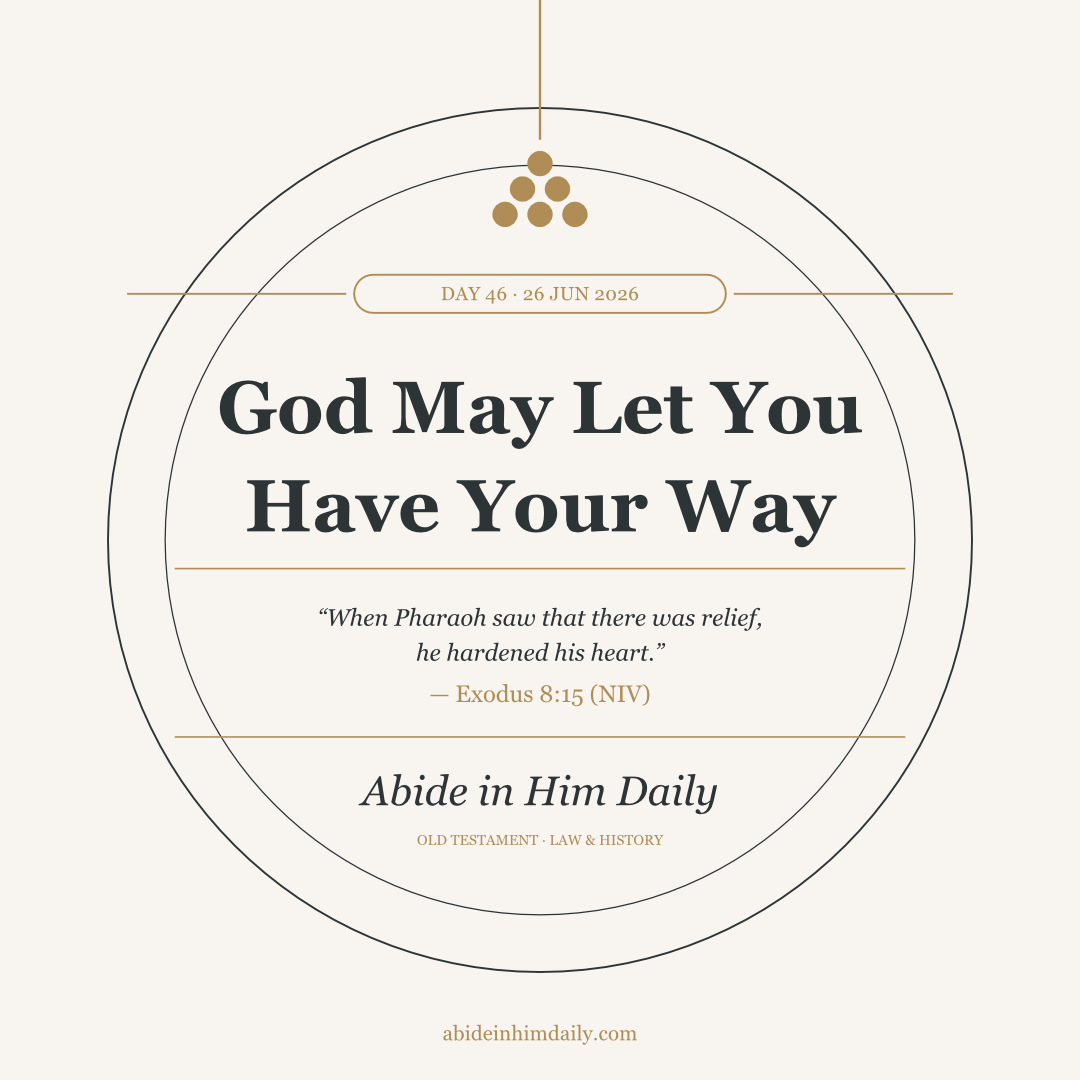
God May Let You Have Your Way
Day 46 · Exodus 8:15
📖 TODAY’S SCRIPTURE
Exodus 8:15 (NIV)
“But when Pharaoh saw that there was relief, he hardened his heart and would not listen to Moses and Aaron, just as the Lord had said.”
Today’s John 15 thread: Abiding in the Vine means surrendering our will to His, because the Vine knows what we don’t. Pharaoh insisted on his own way, and God eventually let him have it. But having your own way came at an enormous cost. Submission to God doesn’t limit us. It protects us from the damage that comes from insisting on our own path.
✍️ REFLECTION
Nine plagues. Nine chances to change his mind. Every single time there was a moment of relief, the frogs died, the flies went away, the hail stopped, Pharaoh hardened his heart again. The pattern is almost painful to watch. He gets a reprieve, lets go of his stubbornness just enough to ask Moses to pray for the plague to end, and the moment the pressure is off he goes right back to the same position. And through much of it, the Bible says: the Lord hardened Pharaoh’s heart.
Q1: Has there ever been a season in your life when you knew you should change direction, but the moment the pressure let up, you went back to the same patterns? What does that cycle look like?
This raises a real question: if God hardened Pharaoh’s heart, how is Pharaoh responsible? The answer is that Pharaoh hardened his own heart first, multiple times, and at some point God gave him what he was already choosing. He let Pharaoh have his way.
That is one of the most sobering things in Scripture. God will not force us to surrender to Him. He gives us genuine choices. But when we consistently choose our own way over His, He may eventually let us have the consequences of that choice. The tragedy of Pharaoh is not just the plagues. It’s the son he lost in the final one, his son who had nothing to do with his father’s stubbornness. Our insistence on our own way never only costs us.
Q2: Are there areas where you have been choosing your own way over what God has clearly said? What are the consequences not just for you but for the people around you?
The mercy in this story is that nine plagues were still mercy. Nine times. Each one was an opportunity. Each one said: stop, change course, let the people go. God is patient. He was patient with Pharaoh through nine rounds of hardened hearts, and He is patient with us too. But there is a point where our consistent rejection of His voice starts to shape us into the thing we are choosing. The heart that keeps hardening gets harder to soften.
Q3: What is God patiently saying to you right now that you have been hardening your heart against? What is stopping you from finally letting it go?
🌿 REMAIN IN HIM
Take a moment before you move on. This isn’t a to-do. It’s an invitation to stay.
Reflect honestly: Is there something you keep doing or refusing to do, even though you know what God has said? Name it. Don’t harden your heart again today.
Bring it to Jesus: Tell Him honestly: “I have been choosing my own way in this area. I don’t want to be like Pharaoh. Soften my heart. I surrender this to You.”
Trust the Gardener: The Vine’s direction is never to limit you. It’s to protect you and make you fruitful. Surrender to it.
🙏 PRAYER
Father, I don’t want to be someone who only softens when the pressure is on and then hardens again when it lifts. Give me a genuinely yielded heart, not just in the hard moments but in the good ones too. I choose to let You have Your way. In every area where I have been insisting on my own, I surrender. In Jesus’ name, Amen.
💡 MEMORY VERSE
Hebrews 10:31 (NIV): “It is a dreadful thing to fall into the hands of the living God.”
This post is part of the Abide in Him Daily devotional series, reading Scripture through the lens of John 15:1–17. The branch doesn’t manufacture the fruit. It bears it because it stays connected to the Vine.