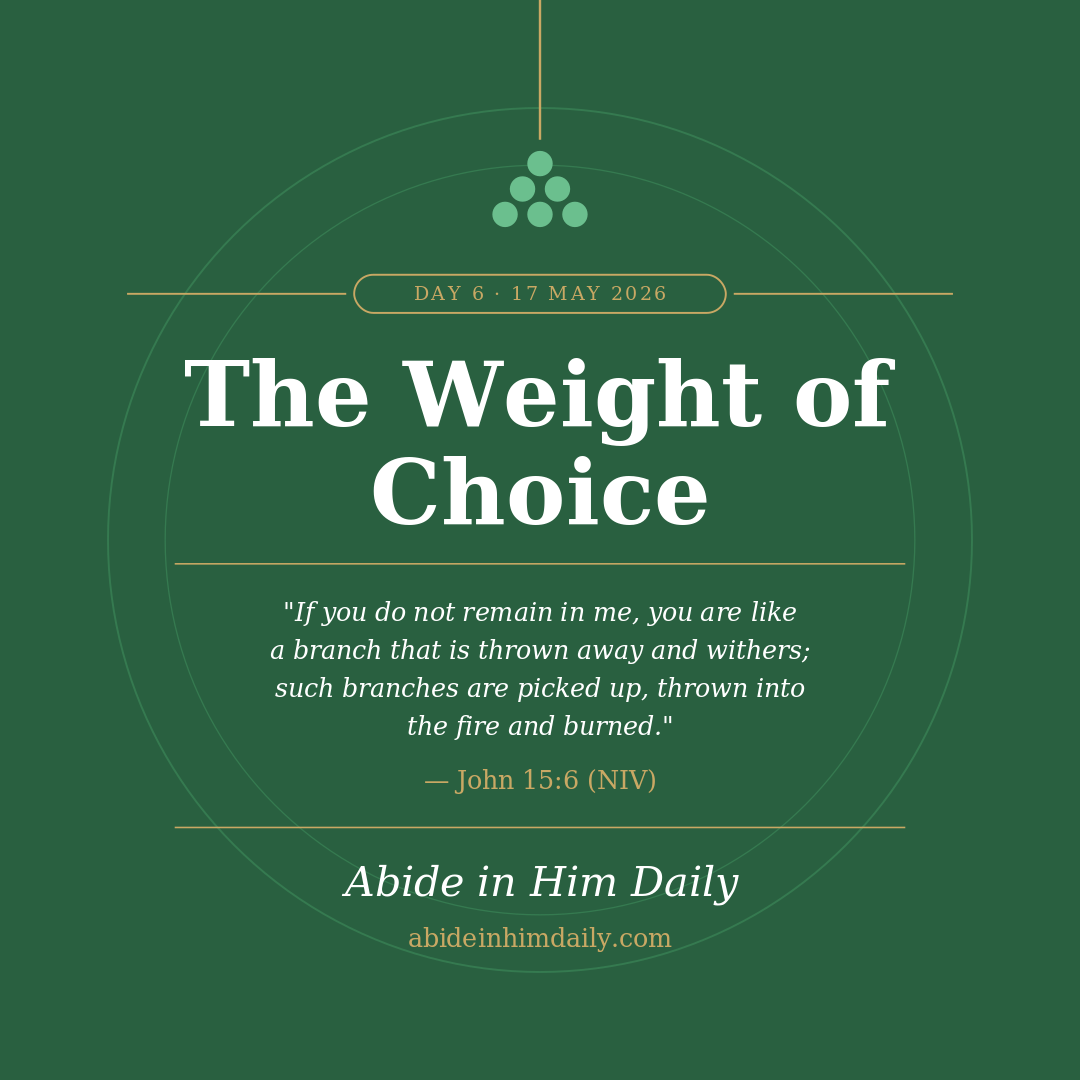
The Weight of Choice
John 15 Series — Day 6 | John 15:6
📖 TODAY’S SCRIPTURE
John 15:6 (NIV) “If you do not remain in me, you are like a branch that is thrown away and withers; such branches are picked up, thrown into the fire and burned.”
REFLECTION
“If you do not remain…”
Jesus is not threatening His disciples here. He is not blackmailing them into obedience. He is simply — and clearly — pointing at the consequence of a choice.
In science, we learn this early: every action has an equal and opposite reaction. Not good or bad, just real. The point is not the moral weight of the outcome — the point is that every choice, every decision, every action we take carries a consequence, whether we acknowledge it or not.
Vanessa and I teach our boys, Caleb and Aaron, the same thing. You are free to make your own choices — but every choice has its consequences. That understanding is not meant to frighten them. It is meant to grow them. Because if they can grasp the weight of consequences, they will begin to understand what a good choice looks like — and what a bad one costs.
Adam and Eve knew this. God had told them exactly what would happen if they doubted His goodness and trusted the enemy instead. They were not ignorant of the consequence. They made the choice anyway. And the consequence arrived — not as punishment from an angry God, but as the natural result of disconnecting from the source of life.
God’s plans are to prosper us and not to harm us — plans for hope and a future (Jeremiah 29:11). But even the best plan requires a choice to walk in it. God does not force the path. He sets it before us. And every day, I choose whether to remain on it or quietly step off.
Q1: What choices am I making right now — even small, quiet ones — that are slowly moving me further from the vine?
What actually happens to a dead branch?
When Jesus says the branch is thrown into the fire, many readers immediately hear hellfire and eternal judgment. But I want to sit with what this actually meant to the people standing in front of Jesus — farmers, fishermen, people who had worked vines their whole lives.
In a first-century vineyard, a dead or unproductive branch was cut away so it wouldn’t drain the healthy parts of the vine. Once dried out, that branch had almost no practical use. Grapevine wood is too twisted and brittle to build anything from. So it was swept up and used as kindling — tossed onto the household fire as fuel for the day’s cooking. This is the everyday picture Jesus is painting. Not a courtroom. Not a verdict. A gardener at the end of a day’s work, gathering the dead wood, and putting it to the only use it has left.
And I think this makes the warning more searching, not less. Because the question Jesus is really asking is not are you going to hell? — it is: are you producing anything? A branch connected to the vine bears fruit. A branch that is cut off dries up and becomes useful only as fuel. The consequence of not remaining is not primarily punishment. It is uselessness. It is wasted potential. It is the loss of everything the branch was made to produce.
Q2: Is there any area of my life right now where I have been going through the motions — present in appearance, but slowly drying out on the inside?
The difference matters
It is worth noticing that when Jesus speaks of eternal judgment in Matthew and Luke, He uses a specific phrase: πῦρ αἰώνιον — eternal fire. He does not use that phrase here. The fire in John 15:6 is the everyday fire of a vineyard worker burning garden refuse. Jesus is not describing the last judgment. He is describing the natural outcome of a disconnected life — one that stops bearing fruit and eventually becomes unrecognisable from what it was meant to be.
This does not soften the warning. It sharpens it. Because it means the consequence is not distant or abstract. It is happening in the daily decisions I make to remain — or not to remain — in Him.
Q3: If I am honest, am I currently drawing life from the vine — or have I been running on my own reserves for longer than I would like to admit?
🌿 REMAIN IN HIM
Take a moment before you move on. This isn’t a to-do. It’s an invitation to stay.
Reflect honestly: What is one area of your life where you are quietly going through the motions — showing up, doing the right things — but no longer drawing life from the vine? Not where you think you should be. Where you actually are.
Bring it to Jesus: Don’t clean it up before you come. Sit quietly and say: “Lord, I don’t want to be a branch that just dries up. I want to remain. Show me where I’ve disconnected — and help me come back.”
Trust the Gardener: The Gardener knows the difference between a branch that is dead and a branch that has drifted. You are still here. Still reading. Still reaching. That is not nothing — that is the beginning of remaining. Come back to the vine. Life flows from staying.
🙏 PRAYER
Father, I know the plans You have for me are good — plans to give me a future and a hope. But those plans require a choice, and the choice is mine to make every single day. Today I choose to remain. Not because I have been consistent, not because I have earned my place on the vine — but because apart from You I have nothing worth offering. Prune what needs to be pruned. Remove what is taking up space without producing life. And help me to stay connected to You — the only source of anything real. Amen.
💡 MEMORY VERSE
Deuteronomy 30:19 (NIV) “This day I call the heavens and the earth as witnesses against you that I have set before you life and death, blessings and curses. Now choose life, so that you and your children may live.”