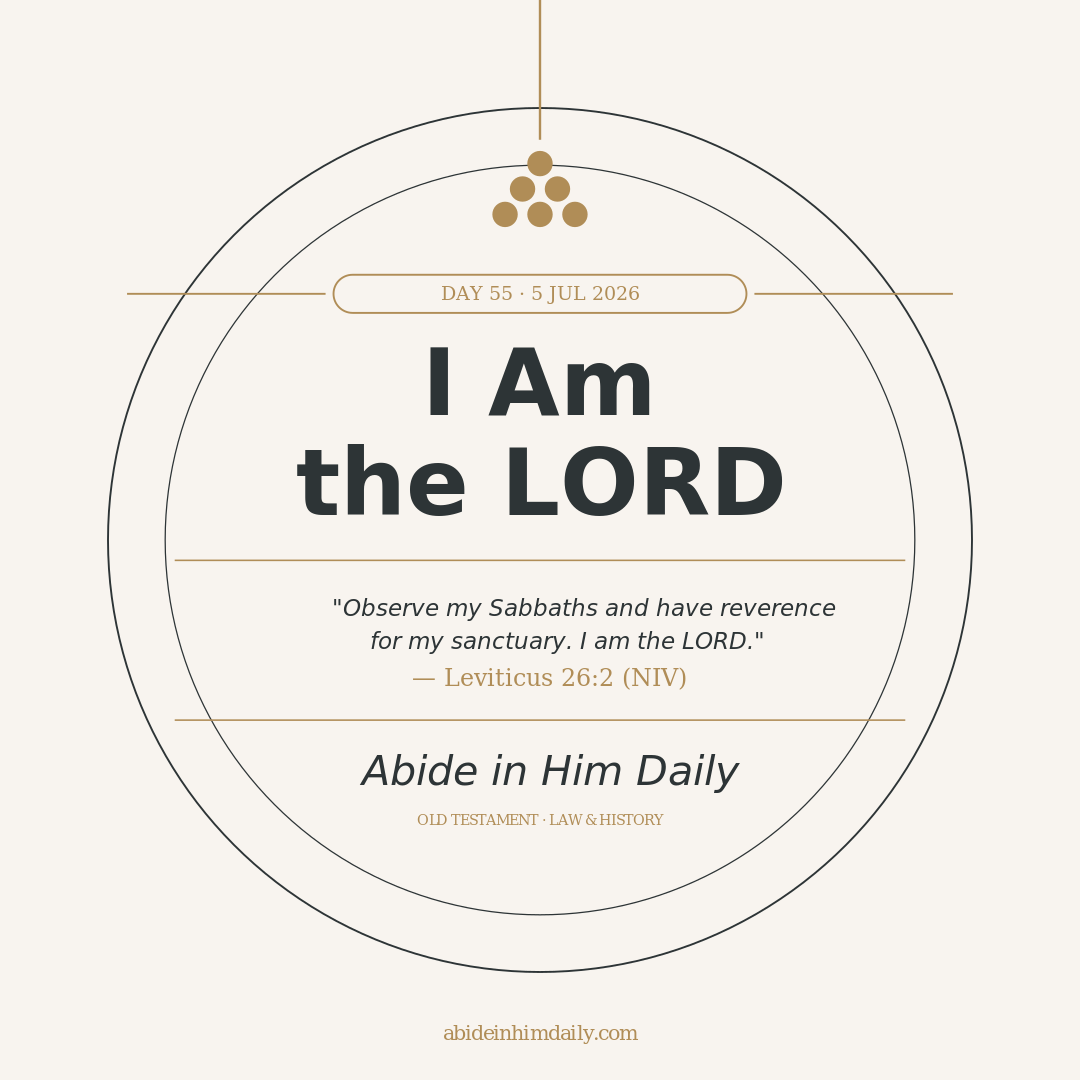
I Am the LORD
Day 55 · Leviticus 26:2
📖 TODAY’S SCRIPTURE
Leviticus 26:2 (NIV)
“Observe my Sabbaths and have reverence for my sanctuary. I am the LORD.”
Today’s John 15 thread: Abiding in the Vine begins with knowing who the Vine is. Every command God gives in Leviticus ends the same way — “I am the LORD.” He doesn’t give instructions anonymously. He signs His name to every word He speaks. The branch doesn’t question the Vine. It stays connected because it knows whose it is.
✍️ REFLECTION
Leviticus can feel like a long list of rules. But if you read it carefully, you notice something. Almost every command God gives in this book ends with the same phrase: I am the LORD. It appears over and over, sometimes twice in a single sentence. God gives an instruction, and then He says who He is.
That is not decoration. It is the reason.
The commands in Leviticus are not floating rules issued by an authority nobody knows. Every single one comes with a name attached. And the name is not just a signature — it is a statement about who is speaking and why that should matter to you.
“Observe my Sabbaths and have reverence for my sanctuary. I am the LORD.”
Notice what this verse holds together: rest and reverence. Stop when I say stop. Stand in awe of where I dwell. And the reason is not because the rule makes sense to you. The reason is because the One giving it is LORD.
Q1: When you obey God, what is the reason behind it? Is it because the instruction makes sense to you, because you fear consequences, or because you genuinely trust the One who gave the command? Sit with that honestly.
Leviticus 26 goes on to describe what faithfulness looks like over time. “If you follow my decrees and are careful to obey my commands,” God says, “I will send you rain in its season, and the ground will yield its crops.” God is not vague about what obedience produces. He posts His blessings clearly, the same way He posts His warnings clearly.
This is not a transaction. God is not a vending machine where obedience drops a blessing. But there is a design to creation, and living inside that design — under His lordship, within His rhythms — brings a kind of fruitfulness that living outside it simply cannot.
Q2: Is there an area of your life where you have been making decisions without really asking: what does the LORD say about this? What would it look like to bring that area under His name?
The phrase “I am the LORD” is one of the most repeated statements in all of Scripture. God says it constantly — not because He needs to remind Himself, but because we need to be reminded. Our default is to treat God’s instructions as suggestions, to pick the ones that suit us and quietly set aside the ones that cost us something. “I am the LORD” cuts through that. It calls us back to the basic fact: He is Lord and we are not.
Q3: How fully does your everyday life reflect the lordship of God? Not in theory but in practice — in your decisions, your time, your money, your relationships. What would it mean to live today genuinely remembering: He is LORD?
🌿 REMAIN IN HIM
Take a moment before you move on. This isn’t a to-do. It’s an invitation to stay.
Reflect honestly: Go back to the phrase: “I am the LORD.” Let it land — not as a theological statement but as a personal one. He is Lord of your schedule, your relationships, your fears, your plans. Is there something you are holding onto that you have not yet placed under His lordship?
Bring it to Jesus: Tell Him: “Lord, You are the LORD. Not just in theory. Help me to live today as someone who actually believes that.”
Trust the Gardener: The branch doesn’t get to decide what the Vine requires. But it also doesn’t have to worry — the Vine knows what it is doing. Trust the One whose name is above every name.
🙏 PRAYER
Father, thank You for not giving commands from a distance. You attach Your name to every word You speak. You are not anonymous — You are LORD. Help me to live today remembering that. Help me to stop treating Your instructions as optional suggestions and start treating them as words from the One who made me, loves me, and knows exactly what I need. I want to live under Your name, not just call myself by it. In Jesus’ name, Amen.
💡 MEMORY VERSE
Leviticus 26:2 (NIV): “Observe my Sabbaths and have reverence for my sanctuary. I am the LORD.”
This post is part of the Abide in Him Daily devotional series, reading Scripture through the lens of John 15:1–17. The branch doesn’t manufacture the fruit. It bears it because it stays connected to the Vine.