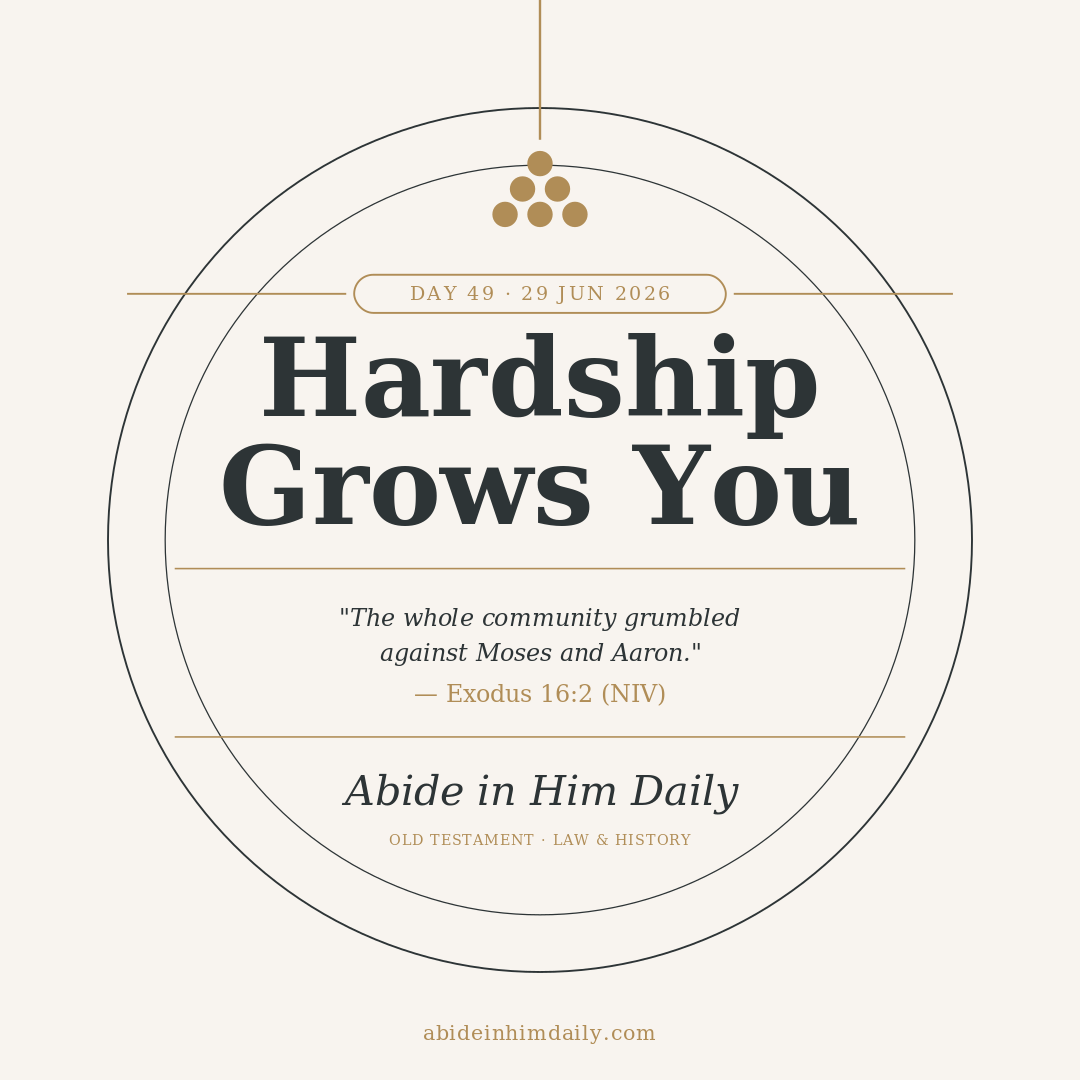
Hardship Grows You
Day 49 · Exodus 16:2-3
📖 TODAY’S SCRIPTURE
Exodus 16:2-3 (NIV)
“In the desert the whole community grumbled against Moses and Aaron. The Israelites said to them, ‘If only we had died by the Lord’s hand in Egypt!'”
Today’s John 15 thread: The Vine produces growth through hardship, not in spite of it. The Israelites’ constant complaining forced Moses to turn to God over and over again. That dependence on God, carved out by the impossibility of the situation, is what made Moses who he was. The branch grows deeper into the Vine when it is pressed on by hard circumstances. That is by design.
✍️ REFLECTION
The Israelites have seen the sea part. They walked through on dry ground and watched God drown the most powerful army in the world. They sang a song of praise on the other side. And within a few weeks they are complaining again. Now there’s no water, and they turn on Moses with exactly the kind of thing that would break most leaders: “Why did you bring us up out of Egypt to make us and our children and our livestock die of thirst?”
Moses’ response is the one that really matters here. He doesn’t argue. He doesn’t give a motivational speech. He cries out to God.
Q1: When the people around you make things harder, when leadership is exhausting, when family is difficult, when the people you are trying to serve don’t cooperate, what is your instinct? To argue, to give up, or to turn to God?
Notice why Moses had to cry out to God over and over again. It wasn’t because Moses was weak. It was because the people he was leading were impossible. They gave him no option but to depend on God, because no amount of his own skill or wisdom was going to solve ‘no water in a desert for two million people.’ The hardship of his calling drove him to his knees, and that dependence on God was what shaped him into one of the greatest leaders in history.
Paul says in 1 Corinthians 10:11 that these things were written down as examples for us, not just warnings but examples of what dependence on God in hardship can produce.
Q2: What hardship in your life right now is doing in you what the desert did for Moses, forcing you to depend on God in a way you would not if things were easier?
If Moses had led a comfortable, cooperative group of people who trusted him and made good decisions, would he have needed to cry out to God as often? Probably not. And would he have become the man who spoke with God face to face? Probably not. The hard road was the making of him. There are things you can only learn through hardship and depths of dependence on God you can only reach when your own resources run dry. That is not God being cruel. It is God being thorough.
Q3: Looking back at the hardest season of your life, what did it produce in you that a comfortable season never could have? What do you know now that you could only have learned through that?
🌿 REMAIN IN HIM
Take a moment before you move on. This isn’t a to-do. It’s an invitation to stay.
Reflect honestly: Are you in a hard season right now that is making you want to complain or give up? Let yourself be honest about how hard it actually is.
Bring it to Jesus: Like Moses, cry out. Don’t have a polished prayer. Just bring the honest weight of it and ask: “What are you growing in me through this?”
Trust the Gardener: The branch that is pressed hard by the season produces more fruit, not less. The Gardener knows what He is doing.
🙏 PRAYER
Father, I don’t always like hard seasons. I want things to be easy. But I see what hardship did for Moses, for Joseph, for the people in Your Word, and I want what they had. So I trust You with this. Use what is hard right now to grow me in ways I couldn’t grow in comfort. Make me someone who turns to You every single time, not just when I have no other option. In Jesus’ name, Amen.
💡 MEMORY VERSE
1 Corinthians 10:11 (NIV): “These things happened to them as examples and were written down as warnings for us.”
This post is part of the Abide in Him Daily devotional series, reading Scripture through the lens of John 15:1–17. The branch doesn’t manufacture the fruit. It bears it because it stays connected to the Vine.