
Trust God

  • Right Words, Wrong Direction

    In many cultures — including across Asia and the Middle East — suffering is automatically connected to sin. When a child is born with a disability, when illness hits a family, the whisper follows: What did they do to deserve this? Job’s friends thought the same way. Then Jesus walked past a blind man and His disciples asked: “Who sinned — this man or his parents?” Jesus answered: “Neither.” Today’s devotional looks at what Eliphaz got right, what he got catastrophically wrong, and what Jesus has to say to anyone carrying pain that others have attached to their sin.

  • First Feel the Pain

    Job knew the moves — he could make the fine speeches, shake his head with theological authority. He’d probably done it before his own dark season. But suffering taught him something he couldn’t unlearn: feel first, then speak. In Job 16:4–5 he says to his friends: if I were where you are, I’d choose differently. My words would bring relief, not more weight. Today’s devotional asks whether we’re the kind of people others feel safe bringing their pain to — or whether we move too quickly to fixing, explaining, and advising.

  • My Redeemer Lives

    Job had lost everything — his children, his wealth, his health, his reputation. His friends had become his prosecutors. And from the depths of that wreckage, he made the most confident declaration in the book: “I know that my redeemer lives.” Not I hope. Not I wish. I know. He said it without the New Testament, without the name, without the empty tomb. We have all of that. Today’s devotional asks the honest question: have we slipped from knowing to hoping — and what does it take to anchor ourselves back?

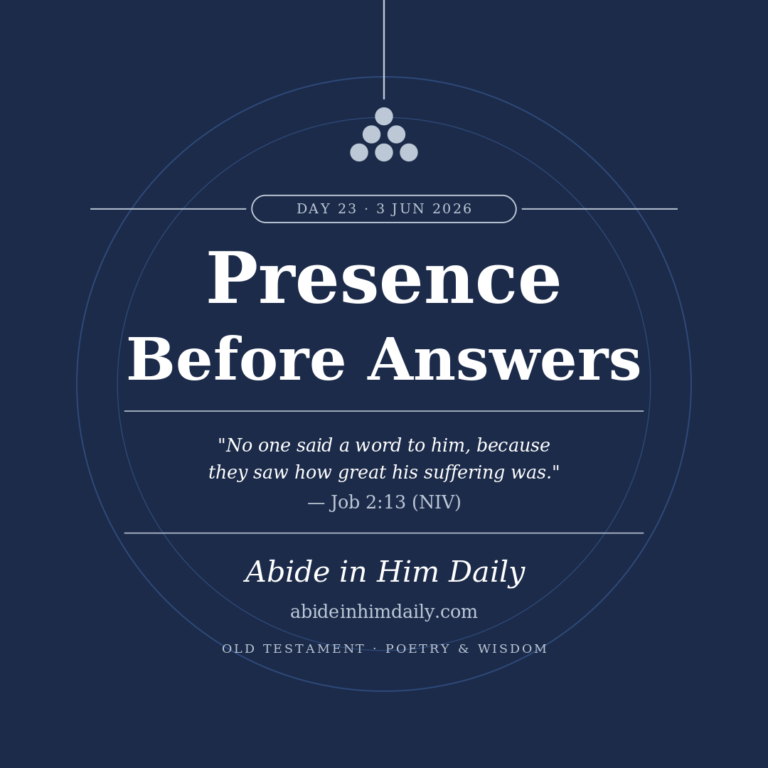
  • Presence Before Answers

    Job’s friends got it right for seven days — silence, presence, sitting on the ground with him. It went wrong the moment they opened their mouths. But here’s what this passage shows us: Jesus wept at Lazarus’s tomb before He raised him. God’s compassion is not a performance. He enters our pain before He speaks into it. And Paul tells us in 2 Corinthians 1 that God comforts us so that we can comfort others with the same comfort we’ve received. You can only give what you’ve been given.

  • God Knows Every Detail

    When you hit the genealogies in your Bible, what do you do? Most of us skip them. But God chose to include page after page of names — and chose NOT to include most of Jesus’s life between twelve and thirty. That’s not an accident. Then Jesus says in Luke 12:7 that the hairs of your head are numbered — not totalled, but individually known. The Greek tense means they HAVE BEEN numbered, they ARE numbered right now. Nothing about your life is too small for His attention.

  • God Takes You Through, Not Away

    God didn’t spare Noah from the flood — He took him through it. The ark wasn’t escape from the crisis; it was God’s provision within it. And Noah built it for 100 to 120 years before a single drop of rain fell to validate what he was doing. Partial obedience is not obedience. Either you are obeying God, or you are deciding which parts of His instruction are worth following. Today’s devotional is for anyone in a season they’ve been asking God to remove them from.

  • Made in His Image

    Of all the things God made — light, sky, sea, sun, creatures of every kind — only one carries His image. You do. Genesis 1:27 isn’t just a creation statement. It’s an invitation: stay close to the One who carries His image fully, and let the reflection show — not because you worked harder, but because you stayed closer.

  • Seventeen Days in the Vine

    We didn’t plan to spend seventeen days here. But John 15 has a way of doing that. Seventeen verses — the vine and the branches, pruning, abiding, laying down your life, being called a friend, being chosen — all of it closing with the same sentence it opened with: “Love one another.” This post is a look back at all seventeen days before we move forward. Because John 15 doesn’t end when the series does. It becomes the lens for everything that follows — Genesis to Revelation.

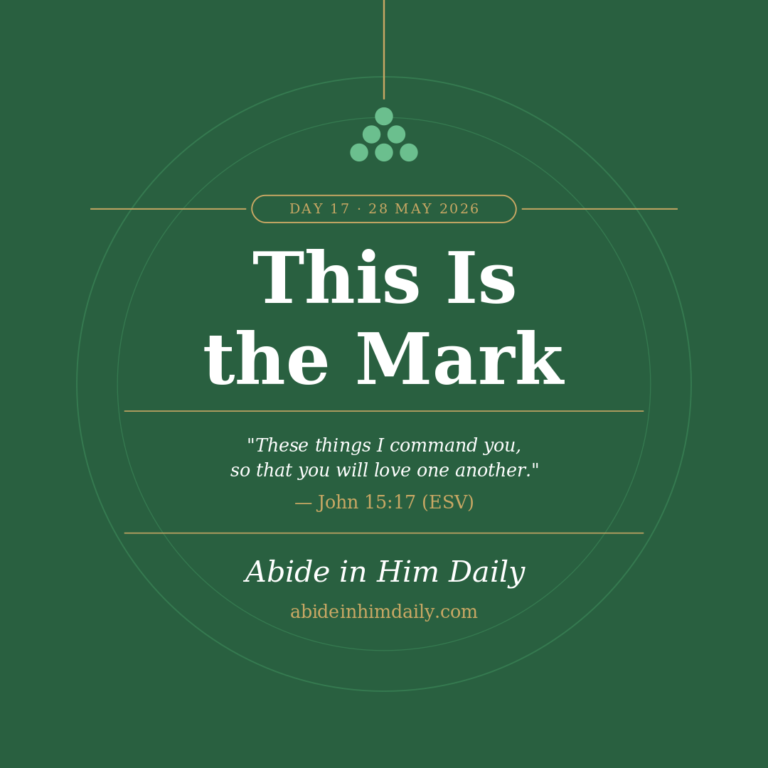
  • This Is the Mark

    Jesus had seventeen verses to say everything He wanted to say. And when He reached the end — after the vine and the branches, the pruning, the abiding, the friendship, the choosing — He said the same thing He said at the beginning. “These things I command you, so that you will love one another.” The scholars call this an inclusio: a literary bracket that signals everything in between was building toward this. The friendship, the choosing, the access — it was all to free you to do one thing well. This is the mark He chose. Not your doctrine. Not your gifts. The love you have for each other.