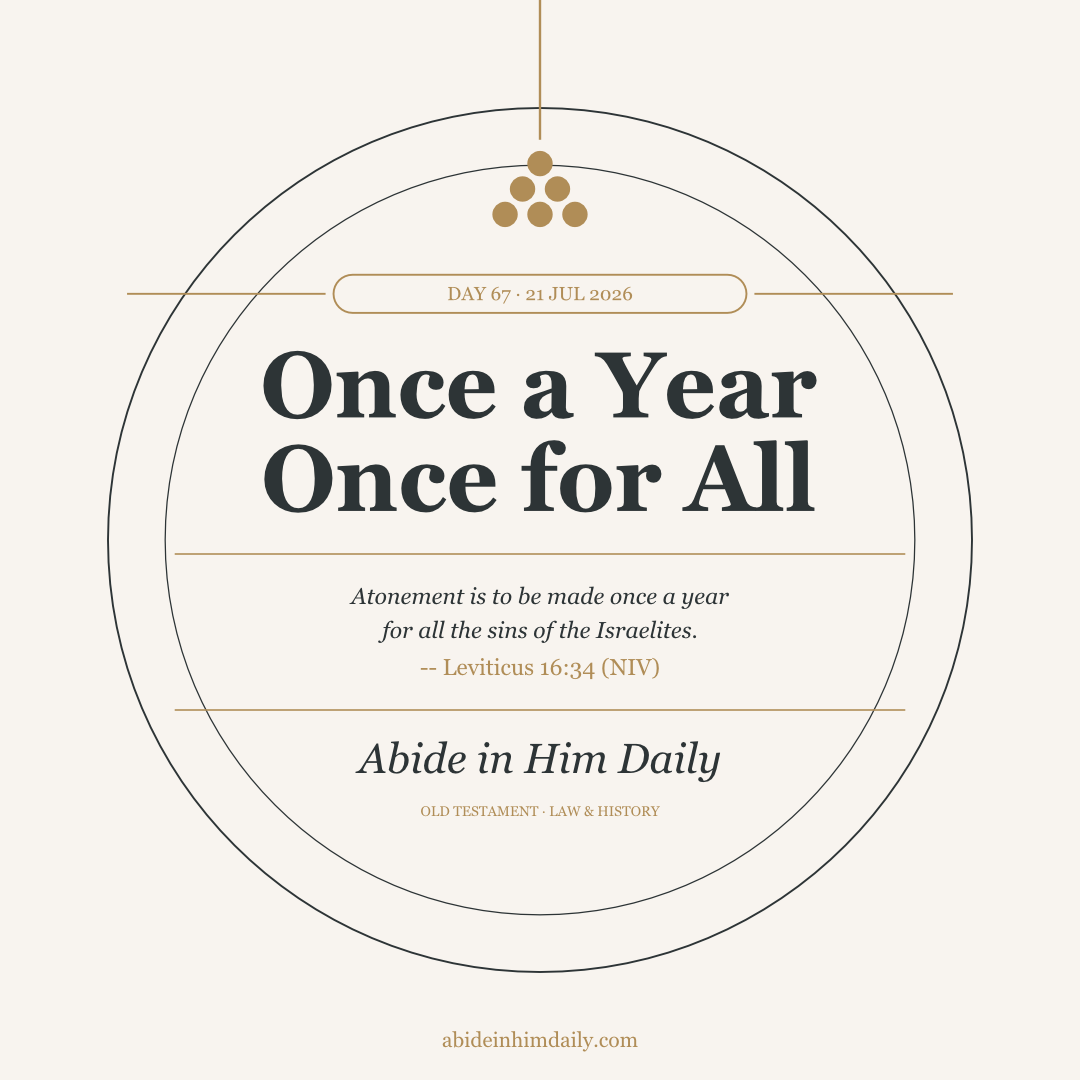
Once a Year, Once for All
Day 67 · Leviticus 16:2, 29-34 · 21 July 2026
📖 TODAY’S SCRIPTURE
Leviticus 16:2, 29-34 (NIV)
“The Lord said to Moses: ‘Tell your brother Aaron that he is not to come whenever he chooses into the Most Holy Place behind the curtain in front of the atonement cover on the ark, or else he will die. For I will appear in the cloud over the atonement cover… This is to be a lasting ordinance for you: On the tenth day of the seventh month you must deny yourselves and not do any work — whether native-born or a foreigner residing among you — because on this day atonement will be made for you, to cleanse you. Then, before the Lord, you will be clean from all your sins. This is to be a lasting ordinance for you: Atonement is to be made once a year for all the sins of the Israelites.'”
Today’s John 15 thread: Every benefit the branch receives — life, nourishment, fruitfulness, forgiveness — flows from the Vine’s own sacrifice. The branch did nothing to earn what it receives. It simply stays connected and draws from what the Vine has provided. The Day of Atonement points to the once-for-all sacrifice that makes everything the branch enjoys possible.
✍️ REFLECTION
Once a year. That was the limit. The High Priest could enter the Most Holy Place — the inner chamber where the Ark of the Covenant rested and where God’s presence dwelt between the cherubim — exactly once a year. Not whenever he felt moved to but once. On the tenth day of the seventh month. On Yom Kippur (Day of Atonement)
And even then, the high-priest cannot come casually. He had to bathe, had to put on the simple white linen of a servant, not the ornate garments of the High Priest. He had to bring incense to create a cloud of smoke so he could not even fully see the atonement cover — because to see the presence of God directly would mean death. And then he offered blood. First for himself and his own household, then for all the people.
He carried the weight of an entire nation’s sin into that room once a year. And then he came back out.
Q1: Try to imagine being the High Priest on that day — the weight of carrying the nation’s sin, the extreme care required, the fact that what you were doing wrong could cost you your life, the single chance in the whole year. What do you think that day was like for him? How does sitting with that image change how you think about what Christ did?
The writer of Hebrews, looking back at all of this in the light of the cross, says something that makes me still.: “Unlike the other high priests, he does not need to offer sacrifices day after day, first for his own sins, and then for the sins of the people. He sacrificed for their sins once for all when he offered himself.” (Hebrews 7:27)
Once for all, not once a year, indefinitely. Once, for all people, for all time and for all sin.
The High Priest under the old covenant came out of the Most Holy Place every year, which meant the sin was covered but not removed. He had to come back. Hebrews 10:4 says bluntly: “It is impossible for the blood of bulls and goats to take away sins.” The animal sacrifices dealt with sin annually but not ultimately. They were pointing forward to the sacrifice that would deal with it permanently.
And then Christ came. He did not enter a room built by human hands. He entered “into heaven itself, now to appear for us in God’s presence.” (Hebrews 9:24) And He brought His own blood, not an animal’s. Every priest in the Old Testament stood to do their work — because the work was never finished. There was no chair in the tabernacle for the priest, because there was always more to do. But Christ sat down, because the work was done.
Q2: “He sacrificed for their sins once for all when he offered himself.” What do you do with that word “all”? All sins — including the ones you committed after you became a Christian? Including the pattern you keep failing at? Including what you will do tomorrow? How deeply do you believe that the atonement is genuinely complete?
I think many of us live more like it is once a year than once for all. We go through a cycle: sin, confession, brief relief, sin, confession, brief relief. We emotionally re-offer the sacrifice ourselves each time — we make ourselves feel the weight of it, we experience the relief, and then we do it again. There is nothing wrong with confession. But there is something wrong with thinking that the sacrifice needs to be re-made, that God’s forgiveness needs to be re-earned through sufficient remorse, that the atonement cover needs to be re-applied for each new failure.
Hebrews 10:14 says: “By one sacrifice he has made perfect forever those who are being made holy.” Perfect. Forever. Not sufficient-for-now-but-we’ll-see-about-next-week. Forever. The one sacrifice was final. You are not living on annual atonement. You are living under once-for-all atonement.
Q3: What would genuinely change in your daily life if you lived from the settled conviction that your atonement is complete — not pending, not provisional, not re-earnable — but done? Not as a reason to sin carelessly, but as the basis for living freely?
🌿 REMAIN IN HIM
Take a moment before you move on. This is not a to-do. It is an invitation to stay.
Reflect honestly:
Are you living under once-for-all atonement, or under the emotional cycle of annual atonement? Be honest about what your daily inner life actually feels like.
Bring it to Jesus:
Tell Him: “I receive it. Not just in theory — I receive the once-for-all atonement as the settled basis of my life with You. I am not pending. I am clean. Help me live from that.”
Trust the Gardener:
The branch lives because the Vine gave itself. Everything the branch enjoys flows from that one sacrifice. You do not earn your place in the Vine each morning. You simply abide in what has already been secured.
🙏 PRAYER
Father, I am amazed that once was enough. That one sacrifice — at one moment in history, by one person, at one cost — covered everything. Everything I have done and everything I will do. I want to live from that settled place, not from the anxious cycle of re-earning what has already been given. Help me to receive the once-for-all atonement as actually final. Let it change how I carry my failures, how I approach You after I fall, how I live on ordinary days. In Jesus’ name, Amen.
💡 MEMORY VERSE
Hebrews 10:14 (NIV): “For by one sacrifice he has made perfect forever those who are being made holy.”
This post is part of the Abide in Him Daily devotional series, reading Scripture through the lens of John 15:1–17. The branch doesn’t manufacture the fruit. It bears it because it stays connected to the Vine.